


Children's Encyclopedia "100K WHYS" - Build Your Child's Ultimate Brain
Children's Encyclopedia "100K WHYS" - Build Your Child's Ultimate Brain
Couldn't load pickup availability
- Amazon pay payment method
- American express payment method
- Apple pay payment method
- Diners club payment method
- Discover payment method
- Google pay payment method
- Master payment method
- Paypal payment method
- Shopify pay payment method
- Visa payment method
-
Ordered
- - -
Order Ready
- - -
Delivered

Children's Encyclopedia "100K WHYS" - Build Your Child's Ultimate Brain
Shipping & Returns
Shipping & Returns
Free shipping on all orders. Most books arrive within 3–7 business days. If your child doesn't fall in love with it within 90 days, send it back for a full refund — no questions asked.
What's in the box?
What's in the box?
Your hardcover copy of "Why 100,000?" a premium, durable encyclopedia packed with vibrant illustrations and 100,000 answers to the questions kids actually ask. Gift-ready packaging included.
90-Day Money Back Guarantee
90-Day Money Back Guarantee
Read it with your kids for a full 90 days. If they're not more curious, more engaged, and asking better questions, we'll refund you in full, no hoops, no hassle.

"Two years of nightly iPad battles, every book abandoned after two pages — five weeks later, I found him reading this at midnight. With a flashlight. Under his blanket."


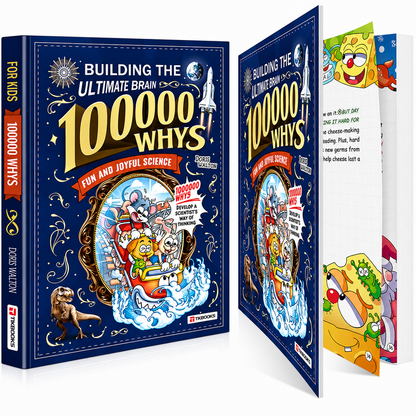

The Book That Answers the Whys — So You Don't Have To
Built around 100,000 questions kids actually ask, explaining the how and why behind every answer. Not facts to memorize and forget — real understanding that sticks. The kind that turns up at dinner, unbidden, as a full presentation on black holes.
One Book. Every Subject They're Curious About.
From the deepest ocean to the edge of the universe — if your child has ever asked "why," the answer is in here.
Space & Universe
Black holes, planets, stars, rockets and life beyond Earth
Dinosaurs
Why they went extinct, how we find them, what they really looked like
The Human Body
Why your heart beats, how your brain works, why you dream
Oceans & Sea Life
Deep sea creatures, why the ocean is salty, how waves form
Weather & Nature
Thunder, lightning, tornadoes, rainbows and the sky
History & Civilisations
Ancient Egypt, the Romans, great inventions and how the world changed
Animals & Wildlife
How animals survive, migrate, communicate and why some go extinct
Science & Physics
Gravity, light, sound, electricity and how everything works
Plants & Biology
How plants grow, why leaves change colour, what makes things alive
The Brain & Mind
Memory, emotions, sleep, dreams and how the mind works
Technology & Inventions
How planes fly, how the internet works, what computers do
Earth & Geography
Volcanoes, earthquakes, tectonic plates and how Earth formed
Why Every Other Book Gets Abandoned
Five things that turn encyclopedias into shelf decoration — and why we built something completely different.
They teach what. Never why.
Facts without understanding vanish by Friday. Real knowledge needs something to grip onto — and standard encyclopedias never give it one.
Everything lives in a silo.
Space never meets history. Biology never touches physics. But a child's brain thrives on connecting the dots — not memorising disconnected boxes.
Dense. Dry. Back on the shelf.
Two pages in, it's abandoned. Not because your child isn't curious — because the book was built for classrooms, not for brains raised on screens.
Built for curriculums, not kids.
Textbooks cover what teachers test. Never the wild questions your child actually asks. Ignore real curiosity long enough — and it quietly disappears.
No match for a screen.
A book that can't hold a screen-trained brain will lose the nightly battle. Every single time. Until the iPad wins by default — and reading becomes something your child "just doesn't do."
Every book that bores your child doesn't just collect dust. It quietly teaches them that reading isn't for them. That curiosity is something to grow out of. Why 100,000? is engineered to change that.
Most books fill a shelf. This one expands a mind.
See how we compare to the encyclopedias already on your shelf. Pick a comparison below.
Different kids, different reasons for buying it — same result. They stopped reaching for the iPad.
I work in tech. I know exactly how these apps are engineered to hold attention, which made losing every night to YouTube feel even worse. We tried educational apps that just became more screen time, chapter books she'd abandon after two pages, nature documentaries that led straight back to the algorithm. I was honestly starting to believe her brain was just wired for the screen and that was that. A colleague mentioned Why 100,000? and I ordered it mostly out of desperation — the 90-day guarantee meant I had nothing to lose. Three weeks later I walked past her room at midnight and she had her lamp off and was reading under her blanket with a flashlight. I stood in the hallway for a full minute. I hadn't felt that good about a parenting decision in two years.
Two years of losing every night to YouTube. Three weeks after this arrived I found her under her blanket at midnight — reading with a flashlight. I stood in the hallway and didn't move. I hadn't felt that good about a parenting decision in two years.
By 7:30pm I have nothing left. I work full-time, commute, come home to dinner and bedtime, and somewhere in there my five-year-old asks 'but WHY?' about forty times. I love him for it. I genuinely do. But one night I snapped — I said 'because I said so' and he looked at me and said 'that's how I learn, Mummy.' I felt awful for a week. I bought Why 100,000? because I needed something that could answer the questions without it always being me. What I didn't expect was how much he'd love it. He doesn't ask me to explain anymore — he brings me the book and shows me what he found. That shift is everything. I actually enjoy the conversations now because I'm not exhausted by them.
I snapped one night and said 'because I said so.' He looked at me and said 'that's how I learn, Mummy.' I felt awful for a week. Now he goes to the book first and brings me what he found. I actually enjoy the conversations now — because I'm not exhausted by them.
I have a graduate degree. I pride myself on being the parent with answers. So when my nine-year-old asked how airplanes stay in the sky and I just… froze… it stung more than I expected. I Googled it, which led us both down a rabbit hole on my phone and learned nothing. That moment bothered me for days. I'd bought him fun fact books before but he'd lost interest in them quickly — they never went deep enough, just trivia with no real explanation behind it. Why 100,000? is different. It doesn't just tell him what — it explains the actual mechanism. Two months in, he came home from school and told me his teacher had asked the class a question about aerodynamics and he was the only one who knew the answer. He explained the whole thing. I didn't prompt him once. That's what I bought the book for.
I have a graduate degree and I completely blanked when he asked how planes stay in the sky. Two months later he came home and told me he was the only kid in class who knew the answer. He explained the whole thing to his teacher. I didn't prompt him once.
*Based on customer feedback and post-purchase survey

Different kids, different reasons for buying it — same result. They stopped reaching for the iPad.